


- More than 140 bilateral agreements on international judicial cooperation currently in force with 53 countries worldwide
- Between 2021 and 2025, mutual legal assistance requests received increased by 244%, while extradition requests received rose by 235%
- Digital transformation reduced the processing time for certain procedures from seven days to just five minutes
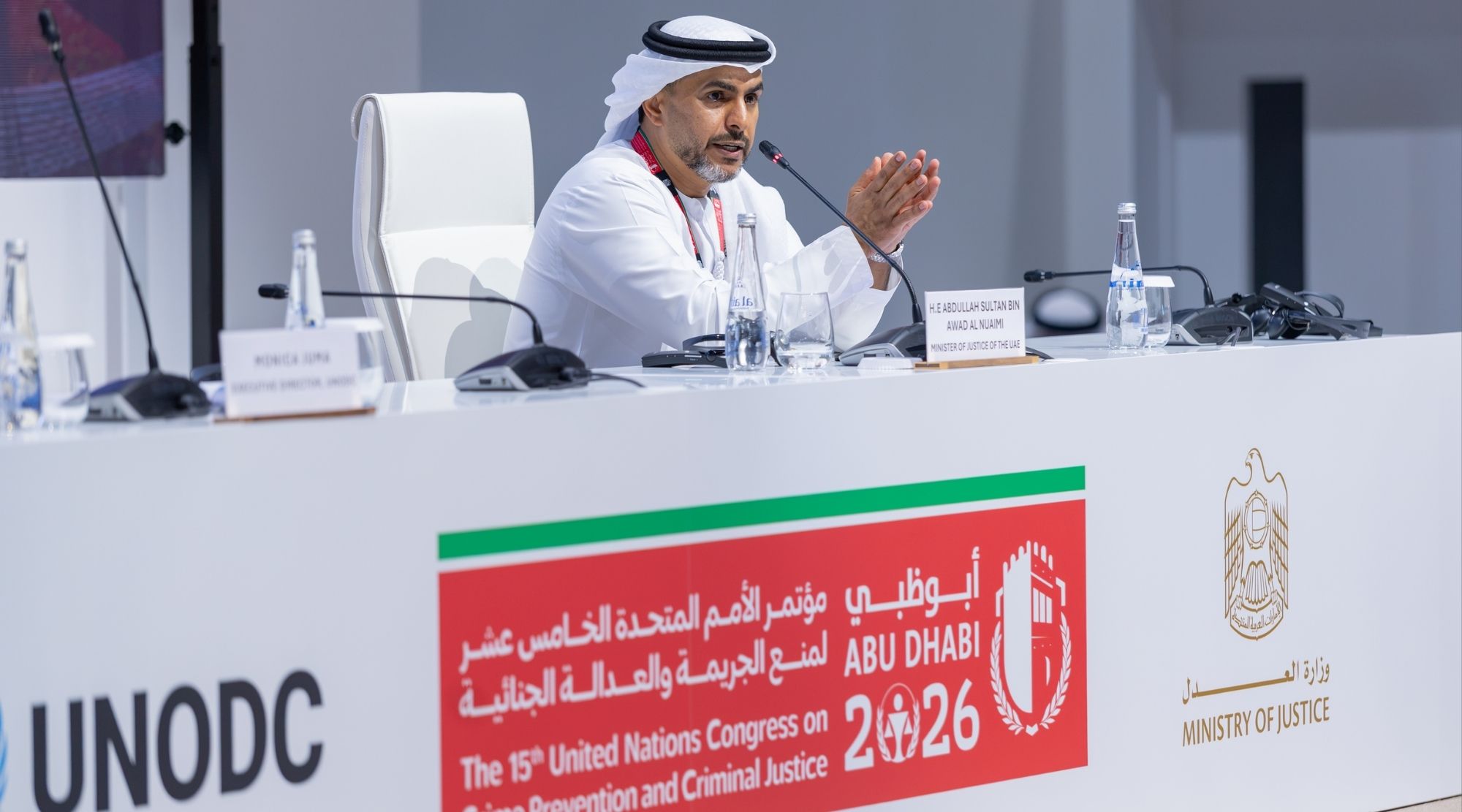
Abu Dhabi-UAE: 27 September 2026 – His Excellency Abdullah Sultan bin Awad Al Nuaimi, Minister of Justice of the UAE and Chairman of the Federal Judicial Council, reiterated that the UAE has established an integrated system for international judicial cooperation that combines robust legal frameworks, direct partnerships, rapid response and digital transformation, preventing borders from being exploited to evade justice or protect the proceeds of crime.
His Excellency made the remarks during the thematic meeting titled “Strengthening International Judicial Cooperation: The UAE Experience and Global Partnerships,” held as part of the high-level segment of the 15th United Nations Congress on Crime Prevention and Criminal Justice – Abu Dhabi 2026. The Congress continues in Abu Dhabi until 1 October, with broad international participation.
His Excellency said: “Crime today has no borders. Criminals, assets, money and evidence can move across several jurisdictions, which means that no country can fight transnational crime in isolation. The UAE’s message is clear: borders should never become a shield for criminals or criminal assets. Our objective is to ensure that effective judicial cooperation enables the proceeds of crime to be traced, frozen, seized and recovered through sound judicial procedures that uphold the rule of law. We see international judicial cooperation as a partnership between countries, built on trust, direct communication, swift action and practical solutions.”
His Excellency explained that the UAE’s approach focuses on making international cooperation faster and more effective, strengthening direct communication with Central Authorities, improving asset recovery, building strong and long-term international judicial partnerships, and ensuring that all procedures remain consistent with the rule of law.
Extensive Legal Network
His Excellency outlined the legal framework supporting the UAE’s international judicial cooperation, which rests on three main pillars: multilateral agreements, bilateral agreements and domestic laws.
He noted that the UAE is a party to 16 universal and regional multilateral agreements and has more than 140 bilateral agreements in force with 53 countries. These agreements cover extradition, mutual legal assistance, asset freezing and confiscation, evidence gathering and the transfer of sentenced persons.
Approximately 30% of the UAE’s bilateral agreements were signed during the past five years. Four additional agreements are ready to be signed before the end of this year, two are currently under negotiation, and a further eight are in draft form.
His Excellency added that federal laws provide a strong domestic legal basis for international cooperation, including provisions on anti-money laundering and countering the financing of terrorism and proliferation. Where no treaty exists, the UAE relies on reciprocity as a key principle of customary international law incorporated into national legislation.
He stressed that effective judicial cooperation begins with integrated domestic coordination among federal and local prosecutions and courts, the Ministry of Foreign Affairs and the Ministry of Interior, alongside cooperation with Central Authorities, judicial bodies and international organisations. In 2026, the UAE held more than 35 bilateral meetings with counterpart Central Authorities worldwide.
International Trust in the UAE
His Excellency noted that incoming international judicial cooperation requests recorded significant growth between 2021 and 2025. Incoming mutual legal assistance requests increased by 244%, while incoming extradition requests rose by 235%, reflecting the high level of trust placed by international partners in the UAE’s legal and judicial system.
In 2025, the UAE received a total of 576 extradition requests. Courts issued decisions in 178 cases, while the remaining requests were either under review or awaiting additional information. The UAE also received 547 mutual legal assistance requests, with the competent authorities issuing 710 reminders to obtain missing information and accelerate their completion.
His Excellency highlighted a practical example of cooperation with Ireland. UAE authorities arrested Daniel Kinahan, a senior leader of the Kinahan Organized Crime Group, within 48 hours of receiving the extradition request. The case underwent a full judicial review, culminating in a final ruling by the Dubai Court of Cassation, before the extradition was carried out on 9 August 2026.
He also referred to a judicial cooperation case with France involving four individuals. Direct coordination between the UAE and French authorities led to the identification and tracing of assets and the seizure of 82 properties in the UAE in November 2025, following execution of the request by the Dubai Public Prosecution.
Digital Transformation and Faster Response Times
His Excellency revealed that the average response time for voluntary extradition had been reduced to five days, while a complete mutual legal assistance request is executed within an average of 35 days, compared with the 60-to-180-day timeframe set out in the International Judicial Cooperation Guidelines.
He confirmed that the International Cooperation Assistance System (ICAS) is fully digital and has reduced the time required to complete certain procedures from seven days to five minutes. The system has also reduced staff effort by approximately 80% and delivered improvements of up to 90% in selected procedures.
His Excellency concluded by affirming that the UAE will continue expanding its treaty network, deepening legal and judicial partnerships, accelerating the exchange of information and evidence, and developing digital tools. These efforts reinforce the UAE’s position as a trusted global partner in combating organised and transnational crime and advancing justice and the rule of law.

more recommended stories
 Abu Dhabi Chamber and FICCI Expand Partnership Between Abu Dhabi and Indian Business Communities
Abu Dhabi, UAE – 9 October.
 JioHotstar Now Available on STARZPLAY Across MENA
~ A dedicated streaming destination within.
 Canada’s Anne Carson wins Nobel literature prize
The Nobel Prize in Literature was.
 Gaza Death Toll Rises to 74,249 Since October 2023
Gaza: The death toll in the.
 EU Electric Vehicle Sales Surge 45% in First Eight Months of 2026
Brussels: Electric vehicle (EV) sales in.
 Vogue Arabia Announces Its Inaugural Vogue Arabia Ball: Art Edition
A new annual celebration under Condé.
 Fortinet and Aramco Sign MoU to Strengthen Industrial Cybersecurity in Saudi Arabia
Partnership to Advance Cybersecurity Localization, Talent.
 First-ever NBA Academy Select Showcase Concludes in Abu Dhabi
Abu Dhabi, United Arab Emirates, 6.
 Investors who followed technology and gaming themes doubled Nasdaq-100 returns over ten years
Technology- and gaming-focused portfolios returned.
 TOD by beIN Partners with GHMZA Group on New Gulf Psychological Thriller Series As its Latest TOD STUDIOS Originals
Kuwait: TOD by beIN, the leading.