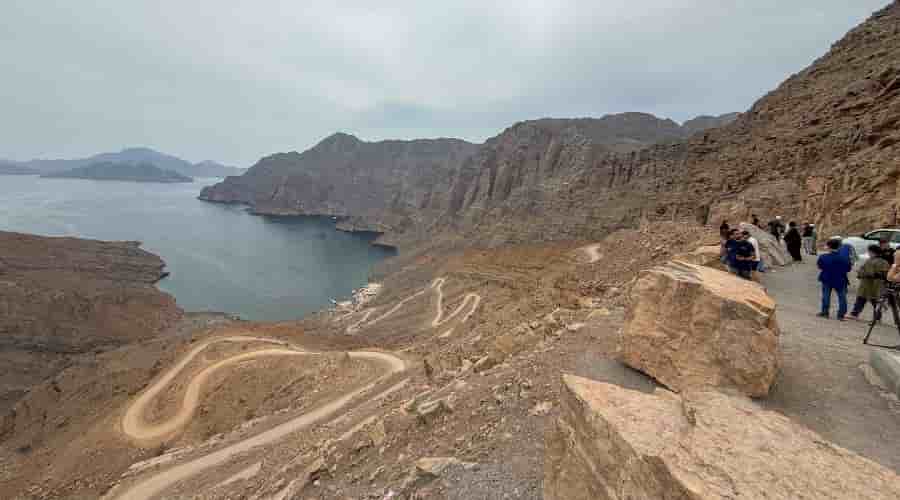




Road Projects in Musandam Boost Economic and Social Development

Musandam
Musandam

Musandam Road Projects Strengthen Connectivity, Tourism and Investment

Khasab:  Musandam Governorate is continuing to implement and develop a number of road projects aimed at strengthening connectivity between its wilayats and regions, improving infrastructure efficiency, facilitating the movement of people and goods, and supporting economic and tourism activities.

The projects form part of efforts to enhance the efficiency of the road network, raise traffic safety standards and improve mobility, while providing infrastructure capable of keeping pace with economic, urban and population growth. They are also expected to open new opportunities for investment and tourism across the governorate.

His Excellency Sheikh Abdullah bin Salem Al-Farsi, Governor of Khasab, said that developing the road network represents a key pillar of the comprehensive development taking place in Musandam, given its role in strengthening connectivity between wilayats, districts and regions, facilitating the movement of people and goods, and improving infrastructure in line with economic and social development requirements.

He highlighted the Sultan Faisal bin Turki Road project (Dibba–Lima–Khasab) as one of the governorate’s most prominent strategic projects, describing it as a qualitative advancement in transportation and connectivity and a project that will enable greater utilization of Musandam’s economic, tourism and development potential.

He noted that investment in road infrastructure constitutes an investment in sustainable development, contributing to Musandam’s attractiveness to investors, improving access to promising tourist and economic sites, and supporting productive and service sectors.

Such projects also contribute to diversifying economic activity, encouraging private-sector investment and strengthening the governorate’s competitiveness, he added.

His Excellency explained that infrastructure development in Musandam is being implemented within an integrated development vision and in coordination with relevant authorities to ensure alignment with national priorities and community needs.

He stressed that the coming phase will witness continued implementation of strategic projects aimed at improving quality of life, strengthening the foundations of economic and tourism development, and consolidating Musandam’s position as a promising tourism and investment destination in line with the objectives of Oman Vision 2040.

For his part, Engineer Badr bin Ahmed Al-Shehhi, Director of the Roads Department in Musandam Governorate, said that the Sultan Faisal bin Turki Road project is among the governorate’s most important strategic and vital projects, owing to the direct connectivity it provides between its wilayats and regions.

He explained that the road extends for about 70 kilometres, reducing travel time between Dibba and Khasab from around three hours to approximately 55–60 minutes. The project will also reduce travel time between Lima and Khasab from about two and a half hours to approximately 20 minutes.

The project is expected to strengthen logistical and social connectivity and reduce the geographical isolation of several remote coastal areas, particularly Lima, which previously relied to a large extent on sea and air transportation.

The road will provide citizens and residents with safer and easier movement while facilitating the transportation of goods and essential services under different weather conditions.

Al-Shehhi added that new road projects, together with rehabilitation and maintenance works, have contributed to improving traffic safety, raising the efficiency of the road network and accommodating population growth, while enhancing the sustainability of infrastructure amid the governorate’s challenging geographical conditions.

Regarding the prioritization of road projects, he said that the Ministry of Transport, Communications and Information Technology applies a unified governance mechanism known as the Matrix for Determining and Ranking Road Project Priorities.

The mechanism aims to ensure transparency and fairness in distributing projects while aligning them with the objectives of Oman Vision 2040 and the governorate’s regional urban strategy.

The matrix is based on six main criteria covering strategic, economic, engineering and technical considerations, construction and maintenance costs, social and local development requirements, as well as environmental, health and safety factors.

Al-Shehhi stressed that road network development has a direct impact on Musandam’s economic and social development by reducing operational, transportation and logistics costs, supporting productive sectors and strengthening links between ports, industrial areas and different parts of the governorate.

He added that improved roads also help connect mountainous and remote villages with urban centres, facilitating residents’ access to essential services, particularly education and healthcare, while contributing to improved quality of life and social stability.

He noted that the Sultan Faisal bin Turki Road project represents the largest current investment in Musandam’s road network, with a cost exceeding RO151 million.

The project, he said, goes beyond expanding the road network to serve as an enabling component for new economic, tourism and urban development opportunities.

Its completion is expected to create investment opportunities in transportation, tourism, services and other economic activities, while enhancing the utilization of Musandam’s natural and geographical resources.

Al-Shehhi pointed out that implementing road projects in Musandam presents several challenges arising from the governorate’s mountainous terrain, valleys and coastal fronts.

These conditions complicate route selection and construction and require excavation and rock-cutting works, slope and watercourse protection, and specialized solutions for accessing remote locations and transporting equipment and materials.

He explained that addressing these challenges requires detailed engineering planning, geological and hydrological studies, appropriate route selection, and the design of culverts, bridges and rainwater drainage systems capable of handling valley flows.

The implementation of slope and watercourse protection works is also essential, he said, stressing that successful road development in Musandam depends not only on paving but on an integrated system of engineering solutions.

He further highlighted the role of the modern road network in promoting tourism and investment by improving access to tourist sites, connecting wilayats and villages, and facilitating access to mountainous and coastal areas with tourism potential.

Improved connectivity could contribute to the emergence of new tourism and investment destinations, including resorts, camps and mountain and marine activities, in addition to strengthening logistics services and connections with ports, Khasab Airport and the new Musandam Airport.

Regarding future plans, Al-Shehhi pointed to several projects aimed at improving the road network, enhancing safety and increasing traffic efficiency. These include the Khasab–Tibat coastal road improvement project, the Khasab–Al-Khalidiyah road efficiency improvement project, and the paving of the Khor Najd road.

He affirmed that the projects form part of ongoing efforts to develop Musandam’s road network and enhance its readiness to meet the needs of residents and the economic and tourism sectors, while strengthening connectivity between the governorate’s regions and supporting its comprehensive and sustainable development.

more recommended stories

Terms of Use:

  • This website Arabian Daily is an individual’s property, not used for any commercial or sales purposes. What you see here are one’s random thoughts in action. I, by no means, endorse any product or party through this, unless stated explicitly.
  • All work you will find here is copyrighted unless stated otherwise. No part of this work can be reproduced in any way with the exception of a) if you share our work, it should link back to this website; b) if you quote any part of our work, it should be properly credited to us with a link to this website.
  • All images used on this website have been taken from open source image websites on the Internet. If any of them are copyrighted to you and you want us to take them down or add credits, please feel free to contact us here, or by using the contact form on this page.
  • The views expressed on Arabian Daily are solely ours. They do not represent any party or any particular school of thought. This website does not promote racism in any form.
  • Privacy Policy:
    This website will respect the readers’ and the writer’s privacy. We do not sell any of their personal or contact information to another company. We do not put your information on spam lists. Also, and more importantly, we are not responsible for the privacy practices of any of our advertisers or website commenters.
  • Reserve Rights: We reserve the right to change the focus on this website, to shut it down, sell it or to change the terms of use at our own discretion.