


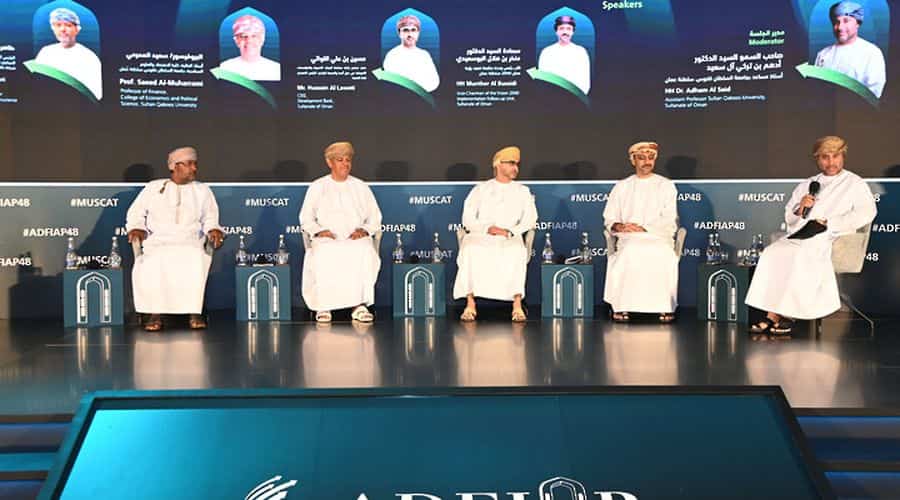
Muscat: The 48th Annual Meeting of the Association of Development Financing Institutions in Asia and the Pacific (ADFIAP) took place today in Muscat.
The meeting is hosted by the Sultanate of Oman, represented by the Development Bank (DB). The meeting, held from 23 to 25 April 2025, focuses on community economic empowerment, development impact in Oman, entrepreneurship ecosystems, aligning capital with development goals, and building sustainable economies.
The inaugural event was held under the auspices of Eng. Said Hamoud Al Maawali, Minister of Transport, Communications and Information Technology. It is themed “Economic Gardening and Development Impact”.
The meeting highlights the pivotal role of development finance in supporting national economic growth.
The ASFIAP meeting brought together around 300 participants from 40 countries, including policymakers, experts, and stakeholders in finance and development.
Mahmood Abdullah Al Aweini, Chairman of the Development Bank, expressed pride in hosting the 48th ADFIAP meetings, calling the organisation a vital driver of national and regional development.
He added that the meeting theme of economic gardening aligns closely with Oman Vision 2040, which serves as a roadmap for sustainable growth, innovation, and the empowerment of local communities under the wise leadership of His Majesty Sultan Haitham bin Tarik.
Al Aweini reaffirmed Oman’s commitment to achieving net-zero emissions by 2050, “Oman has established the Oman Sustainability Centre for Renewable Energy Projects and set ambitious targets for green hydrogen production, goals that can only be realised with the support of development finance institutions like those represented here today,” he noted.
He further highlighted the Development Bank’s commitment to inclusive opportunity and social progress through the financing of diverse projects, fostering local value creation, and building an entrepreneurial ecosystem that empowers youth, women, and communities through targeted finance, training, and strong public-private partnerships.
Hussein Ali Al Lawati, CEO of the Development Bank, underlined the evolving role of development finance institutions. “With their tools and capabilities, these institutions stand at a crossroads where public policy meets entrepreneurship, guiding capital towards sectors that reinforce social cohesion and open new growth opportunities in underserved environments,” he said.
Al Lawati explained that choosing economic gardening as this year’s theme reflects a shift in the development mindset, from importing ready-made solutions to nurturing local potential, from looking outward to enabling internal capabilities, and from relying on traditional resources to investing in human, knowledge, and community capital.
He stressed that supporting small and medium-sized enterprises (SMEs), especially during their growth phases, is an investment in stability, innovation, and social cohesion, ultimately ensuring intergenerational growth continuity.
The meeting programme features sessions on green banking initiatives, sustainable lending practices, environmental risk management, innovative green financing tools, climate resilience strategies, and international cooperation for building adaptive capacities. It also addresses the critical role of second-tier institutions in advancing local economic growth and sustainability.
Dr. Kao Thach, Chairman of the ADFIAP noted that this year’s meetings, held under the theme ‘Economic Gardening and Development Impact,’ are both timely and inspiring. “Under this theme we encourage a reimagining of development as a process rooted in local strength, one that grows from within and starts at the grassroots,” he said.
He explained that “At its core, economic development challenges us to nurture local entrepreneurs, invest in communities, and strengthen ecosystems that allow businesses and innovations to flourish. These elements are powerful levers for addressing global development challenges while supporting inclusive and resilient local economic growth. Through this year’s sessions, participants will explore critical topics such as community economic empowerment, the role of second-tier companies, entrepreneurship ecosystems, goal-aligned financing, financial resilience, and green and sustainable finance, all of which are foundational to inclusive development across the Asia-Pacific region”.
The meeting aims to serve as a platform for knowledge exchange and peer learning on how best to empower communities and achieve sustainable development. It includes important discussions on green finance and the role of development finance institutions in addressing climate challenges, all of which contribute to building economic resilience and achieving the Sustainable Development Goals.
Hamad Salim Al Harthy, Chief MSME & Portfolio Management at DB and General Supervisor of the Meeting, emphasised the significance of the event in reinforcing effective partnerships, empowering communities, and promoting sustainable economic growth through the sharing of ideas and successful practices. He added that the meeting is a unique opportunity to examine the challenges facing financing institutions and how they can be addressed through international cooperation. Oman’s hosting of the event, he explained, stems from its active engagement as a member of the organisation.
Hosting the ADFIAP meetings in Muscat reflects Oman’s growing role in development finance, entrepreneurship, and SME support. It also represents an opportunity to strengthen international cooperation and share best practices in the sector, contributing to the achievement of sustainable development. Oman aspires to enhance its position as a regional hub for finance and development, in line with the strategic priorities of Oman Vision 2040.
Between 2020 and 2024, the Development Bank approved a total of 28,901 loans with a cumulative value of RO 533.9 million, averaging 5,780 approvals annually with a yearly value of over RO 106.7 million. These figures underscore the bank’s central role in supporting Oman’s economy, promoting entrepreneurship, and driving community development.
The industrial sector received the largest share, accounting for 35.6 percent of the total approved value — RO 190.1 million for 6,784 approvals. This was followed by the fisheries sector, which received RO 101.6 million (18.9 percent) for 11,326 approvals, and professional and public services, with RO 70.4 million (13.1 percent) for 4,051 approvals.
Additional loan approvals included RO 65.7 million for tourism services (1,482 approvals), RO 49.2 million for agriculture and livestock (4,405 approvals), RO 30.9 million for education (569 approvals), RO 18 million for healthcare services (243 approvals), and RO 8.3 million for the mining sector (41 approvals). In terms of loan products, large corporate loans accounted for the highest share at 30 percent (RO 160 million), followed by microloans at 26.1 percent (RO 139.5 million), and working capital loans at 25.1 percent (RO 134.2 million). SME loans accounted for RO 98.9 million, and seasonal loans for RO 1.3 million.
The approvals were distributed across all governorates, reflecting the bank’s contribution to balanced regional development. Approvals in Muscat reached RO 134 million, followed by RO 88 million in South Al Sharqiyah, RO 81.3 million in North Al Batinah, RO 55.3 million in South Al Batinah, and RO 52.7 million in Dhofar.

more recommended stories
 117 Companies Benefit from Oman Civil Aviation Authority Local Content Programmes
117 Companies Benefit from Civil Aviation.
 Oman Opens Two Major Road Projects in Al Dakhiliyah
Nizwa: The Ministry of Transport, Communications.
 Oman Reaffirms Commitment to Combating Human Trafficking Ahead of World Day
Muscat, July 29 (ONA) — The.
 Oman Crude Oil Price Falls $9.97 to $87.11 Per Barrel
Muscat: The official price of Oman crude.
 Three Die from Hantavirus in Venezuela, Health Ministry Says
Caracas: Venezuelan health authorities announced today.
 Tender Results of Government Treasury Bills Worth OMR 60.8 Million Issued
Muscat (ONA) : The total issuance.
 LuLu Exchange brings Argentina Fans together for A Football Match Watch Party in Oman
Muscat, Oman – 22 June 2026:.
 His Excellency the Inspector General of Police and Customs issues the Executive Regulations for the National Records Law
His Excellency Lieutenant General Hassan bin.
 Riyada, SEZAD Launch “Riyada Deal” Initiative to Connect SMEs with Investors in Duqm
Duqm: The Small and Medium Enterprises.
 Khazaen Economic City Signs RO 2 Million Food Factory Expansion Agreement
Khazaen Food City Attracts New Investment.