


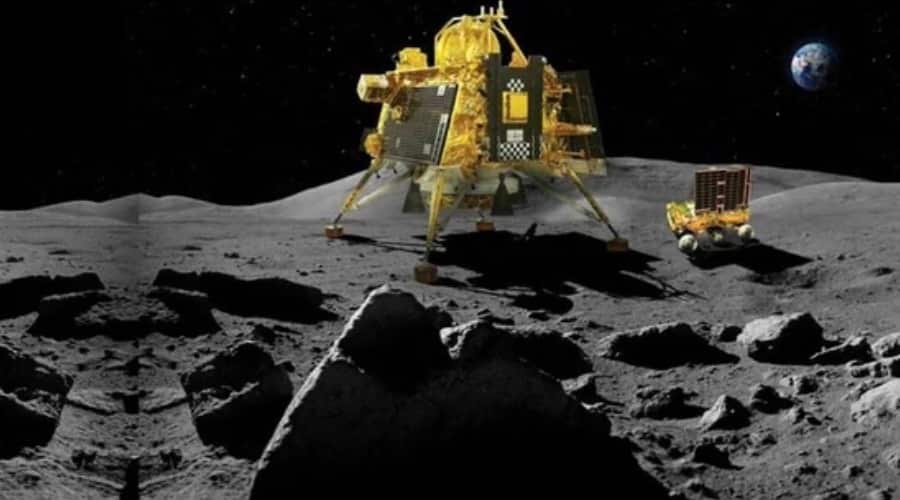
The Indian Space Research Organisation (ISRO) on Wednesday successfully executed the landing of Chandrayaan-3’s Vikram lander on the unexplored South Pole of the Moon, marking the world’s first achievement of its kind.
With this groundbreaking feat, India has secured its place in history as the first nation to successfully land a spacecraft on the Lunar South Pole. The Chandrayaan-3 mission, a testament to India’s progress in space technology, has garnered worldwide attention for its audacious ambition and pioneering spirit.
The Moon’s South Pole presents a unique and challenging environment, characterised by rugged terrains, extreme cold, and constantly changing lighting conditions due to its unique axial tilt. ISRO’s accomplishment reflects the culmination of years of meticulous planning, advanced engineering, and unwavering determination. The Vikram lander’s successful touchdown on this uncharted region is a testament to the dedication and skill of India’s scientific community. The implications of this achievement are far-reaching. The Lunar South Pole has long remained an enigmatic location, holding the potential for invaluable scientific insights and resource exploration. The ability to explore this region opens avenues for unlocking mysteries of the Moon’s history and understanding its geological evolution.
ISRO’s achievement also holds great promise for future space exploration endeavours. As the global space community sets its sights on broader exploration, establishing a foothold on the Lunar South Pole presents new possibilities for sustained lunar presence and scientific research. The Chandrayaan-3 mission’s success not only elevates India’s status in space exploration but also serves as an inspiration for aspiring scientists, engineers, and dreamers across the nation.
It underscores the importance of bold ambitions, meticulous planning, and collaborative efforts in pushing the boundaries of human knowledge. As the nation celebrates this historic accomplishment, the focus now shifts to the scientific discoveries that will emerge from Chandrayaan-3’s Pragyan rover on the Lunar South Pole. The data gathered and insights gained will undoubtedly contribute to humanity’s broader understanding of the Moon, its formation, and its role in the cosmic tapestry. Indeed, India’s achievement with Chandrayaan-3 reinforces the notion that the sky is not the limit, but rather the beginning of a limitless journey into the realms of exploration and discovery.

more recommended stories
 India’s GDP Could Reach $38 Trillion in 20 Years, Says NSA Ajit Doval
India’s Economy Could Reach $38 Trillion.
 At Least 25 Killed in Flash Floods and Landslides Across India
New Delhi: At least 25 people.
 Ammonia Gas Leak at Seafood Plant in India Kills Seven, Injures Dozens
Seven Killed, More Than 40 Hospitalized.
 Oman-India Meetings Focus on Activating Free Trade Agreement
Oman and India Discuss Customs and.
 Indian Embassy in Muscat celebrates 77th Republic Day
Indian Community in Oman Marks India’s.
 India Allows Limited Exports of Wheat Products After Three-Year Ban
India Allows Limited Wheat Product Exports.
 Prime Minister Narendra Modi departed for Oman from Ethiopia
PM Abiy Ahmed of Ethiopia again.
-
India’s PM Modi set to visit Oman next week
New Delhi : Prime Minister Narendra.
 Diwali festival joins UNESCO heritage list
India’s festival of lights, Diwali, was.
 Oman Participates in Global Forum Meeting on Tax Transparency in New Delhi
Oman Highlights Tax Transparency Efforts at.